|
Seachtain
bháid bheag dubh
Five
Day Experimental Currach Workshop
Monday 9th – Friday 13th June 2003
To
be held at Chyvarloe, Porthleven, Cornwall, in connection with the
Porthleven Basket Fair www.basketryandbeyond.org.uk
with Holger Lönze (and hopefully the sailmaker Dave Buchanan)
The
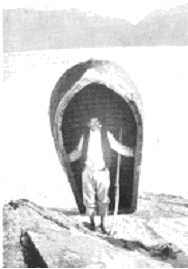
idea of the Seachtain bháid beag dubh is to build a traditional
Bunbeg currach, develop new design ideas and subsequently apply
traditional materials and skills in the building of these new designs.
The
course is open to design students and to anyone who would like to
participate in this exciting event. There will be about 8 places
for students and 8 places for non students. Costs will be £100 for
the week, with accommodation available (£50 for the week) and camping
also possible on site. The course is free for FCA students (except
for contribution to food and accommodation of c. £50). Chyvarloe
is a National Trust property and offers workshop space and self-catering
accommodation (two dormitories and two double rooms). It is situated
on the coast above Loe Bar, an area of outstanding natural beauty,
about twenty minutes walk along the sea to Porthleven (plenty of
pubs and restaurants, large medieval fishing harbour). For bookings,
please contact Hilary Burns 01803 553144, hilary@tiltfund.co.uk,
for more information get in touch with Holger: 01326 213751 or holger.lonze@falmouth.ac.uk.
Description:
Participants will acquire making skills and apply these to new designs
and ideas for boats and floating structures. The focus will be on
basket making skills as applied to skin-boats (curachs and coracles),
this being an important maritime tradition of the Western Seaboard
of Europe, including the West of Britain. During the five day workshop
at Chyvarloe, it is intended to reconstruct from archive photos
a traditional skin boat of willow frame construction (a design from
the Bunbeg area, Co. Donegal) in order to investigate and evaluate
the techniques used in its construction, the application of sustainable
materials, technical solutions required and its overall performance.
In parallel, similar techniques and materials will be adapted by
participants in constructing structures/objects to designs that
have been drawn up on the first day. This five day workshop will
include demonstrations and talks which will give the participants
the opportunity to acquire, practice and develop basic techniques
as well as to gain an understanding of the cultural and historic
context of the products and methods used. It is intended that people
will work in groups of up to three and that 4 to 5 boats/structures
will be built.
The
workshop fits within the wider debate and context of sustainable
materials and contemporary crafts-design. It addresses the transfer
of traditional crafts skills to their application in a contemporary
design context. It is directly related to issues of material culture,
sustainability and design processes. The participants will have
the opportunity for contact with artists, makers and crafts practitioners
also taking part in the Porthleven Basket Fair.
Schedule:
| Monday,
9th June |
Introduction
to materials, techniques and background. Developing designs
and ideas. Trying out techniques.
Starting the gunwale frame. |
| Tuesday,
10th June |
Working
on the frame and skeleton of the structure |
| Wednesday,
11th June |
Finishing
the main structure |
| Thursday,
12th June |
Covering
and waterproofing |
| Friday,
13th June |
Finishing
and sea trials, celebrations…
Talk on Irish currachs in the village hall
End of official workshop, but for all interested and keen: |
| Saturday,
14th |
Talk
on FCA/Eden collaborative research project (to be confirmed) |
| Sunday,
15th June |
Participation
in the ‘Water Gala’ event with the boats |
One or two currachs will be available for rowing and fishing trips
during the week. Some films/videos around the subject will be shown
and plenty of relevant literature will be available for reading.
Historical
and folk-lore background:
The skin boat tradition is one principal root of European boat building,
its origins go back at least to Mesolithic times. Their use once
stretched from the circumpolar region down to the Mediterranean
(Galicia) and some individual types developed in Iraq (quffah) and
Tibet. Their distribution is now limited to the Western seaboard
of Europe, mainly Ireland and Greenland.
The distribution of currachs on the Atlantic seaboard of Ireland
stretches from the North coast down to the Dingle peninsular in
the far southwest. The regional differences between the boats are
astonishing, ranging from 8’, archaic and simply built currachs
of the Bunbeg area to the sophisticated 25’ náomhóga of the Blasket
Islands in Co. Kerry which is able to hold 2-3 tons of fish. These
differences reflect the adaptation to their particular environment,
needs of the users and availability of material. The keel-less and
light currach, fragile but enormously seaworthy, is hence a beautiful
symbol for the challenge of man to the overpowering ocean. For centuries
it has been the economic, social and cultural centre point of the
isolated communities of the far West. With great ingenuity, currachs
were constructed from the cheapest materials (driftwood, flourbags,
withies and tar pinched from the council…) with simple techniques,
allowing their builders to sustain a living from them within a few
days. Owing to this low key approach, currachs were never given
names!
| The
Bunbeg currach has been developed for the use in long shallow
areas of water on the North coast of Ireland and for swift launching
from Donegal’s sandy beaches. The flat hull shape reflects this
adaptation to the particular coastal environment and the keel-less
construction adds to its great manoeuvrability at sea. |
 |
It
is light enough to be carried to the water by one person, yet it
is able to carry five or more people over the deep inlets (loughs)
of the sea in this area. It can be rowed as well as sculled with
a paddle over the front (a skill that will be fun for the participants
to learn …). Like all currachs, it is very versatile, being used
for long line and net fishing, transport of goods and people, or
simply for leisure or the occasional cattle raid.
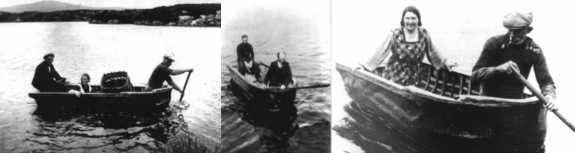
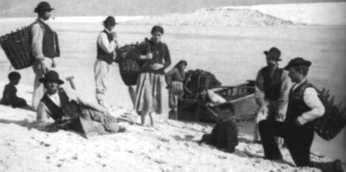
Archive
photos of the later type of Bunbeg currach (c. 1950s)
Technical
information:
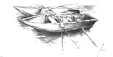
| While
a later type of Bunbeg currach was built with wooden laths and
a single gunwale frame, its early type was of much simpler construction.
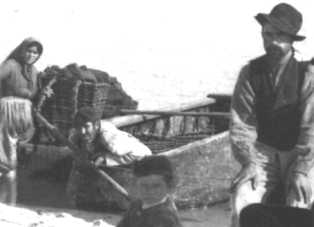
Some archive photos show the use of willow for the main structure
of the body. Rods, possibly up to ¾” thick were inset in a single
gunwale frame and paired with their opposite member. |
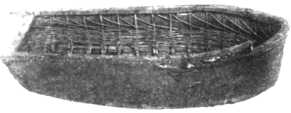 |
| To
stiffen the structure, thinner ½” withies were introduced at
each of these ribs and were woven into a stiff side wall, using
French randing (see photos below). It is somewhat unclear from
those archive photos, how the longitudinal stringers were connected
to the ribs (tied?). This is one of the challenges of the workshop… |
|
The
gunwale frame is made of timber, possibly in 5 sections (stern,
main gunwales, two shoulder pieces and a bow section) not
unlike the later type. Simple lap joints were used and holes
for the ribs drilled or burnt in with a small lump of turf.
The frame is built first, the whole boat is built upside down.
The
cover was originally hide, but was replaced in the mid 19th
century by canvas (flourbags) that was waterproofed with coal
tar (we will use bitumen roof paint or pitch).
|
 |
The cover is tacked onto the gunwale, partly darted. The dimensions
are in the region of 8-9ft, c. 3ft width (beam), 2ft deep; it is
light enough to be carried by one person (c. 30-40lbs). Propulsion
is and was either by a single paddle over the front (with a figure
of 8 motion) or a pair of rowing sticks.

Images
of the scale model
Design
considerations:
Although widely ignored by boat designers, the skin-boat offers
a variety of advantages over other boat construction methods. It
is extremely light, inexpensive (max. £150 for the material for
a 17’ Dunfanaghy currach!), simple to build and versatile in use.
No mooring is needed, it can be launched from inaccessible locations
and hardly needs any maintenance.
Notably the materials used in its construction meet the challenge
of sustainable design: nearly all materials are from abundant, sustainable
resources, many can be recycled, it can be repaired very simply
and is bio-degradable. The materials have low embodied energy and
their appearance is æsthetically rather pleasing.
The
starting point for new designs will be the material involved and
their individual function: timber for the gunwale (structural strength),
coppiced hazel and willow (creating volume, space) and tarred or
pitched canvas (waterproofing). The combination of the materials
leads to a rigid but very light vessel.
As
far as the design is concerned, anything goes that swims, floats,
carries 1 to 16 people and is made using the materials provided.
Given the limitation of materials, size should be restricted to
max. 10ft length. The designs should reflect the philosophy of the
currach: cheap, found and recycled materials assembled in short
time with simple techniques and a minimum of technology. Please
start developing some ideas for new designs in advance of the workshop
and bring them with you, so we are able to work out of a pool of
ideas on the first day and make a swift start. It is intended to
bring the sail maker Dave Buchanan in at this stage to assist with
the development of designs and to give advice on the making process.
References
and Literature:
Hornell, James; British Coracles and Irish Curraghs, London, 1938
MacCullagh, Richard; The Irish Currach Folk, , 1993
Hogan, Joe; Basketmaking in Ireland, Dublin, Dublin, 2002
McGrail, Seán; Ancient Boats in N.W. Europe, London, Longman, 1987
http://www.mmara.com/history.html
http://www.geodesicairoliteboats.com/
http://homepage.ntlworld.com/christopher.sauvarin/Home1.html
http://homepage.ntlworld.com/christopher.sauvarin/Bernd_Unstaedt1.html
What
to bring:
Some design ideas, details, sketches, etc. old bedsheets, tea towels,
old tarpaulin, socks etc. for the covering basic tools: hammer,
saw, secateurs, knife, scissors, string (ideally marlin twine) working
clothes, waterproofs, walking boots If you have any, please bring
a life jacket (in case of any design flaws…), odd pieces of wood
(up to c. 6-7ft in length) and a sewing machine. Materials such
as willow, hazel, some timber, nails and pitch will be provided.
Contact
Us 
|